

 February 2026 • Briefing Note 100 •
Bangladesh as a laboratory of political reconfiguration in South Asia
South Asia is undergoing profound political shifts driven by youth movements and a rejection of traditional elites, amplified by social media. The weakening of established power structures is fostering the rise of new actors but also generating lasting instability, fuelled by economic hardship, strong social expectations, and limited state capacity. Bangladesh illustrates these dynamics: after decades of bipartisan dominance and a period of relative stability under the Awami League, the 2024 uprising opened a phase of deep political uncertainty. Economically, the interim government’s main challenge is now to restore the confidence of investors and trade partners.
Responding to the demands of the Monsoon Revolution
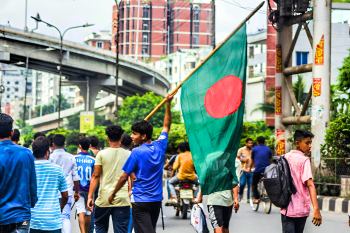
The July 2024 movement, which began as a student protest against a controversial quota system abolished in 2018 but reinstated by the Supreme Court, transformed into a nationwide uprising against corruption, favouritism, and rising living costs, triggering the fall of Sheikh Hasina on 5 August. Her departure set off a period of profound instability. Muhammad Yunus was appointed Chief Adviser to lead an interim government tasked with organising elections and developing a political charter. The authorities have moved to sideline the Awami League, while charges of crimes against humanity have been brought against Hasina, heightening tensions with India. At the same time, the National Consensus Commission is drafting a charter on institutional reforms, supported by many parties yet contested by the BNP and others. The announcement of elections for February 2026 responds to domestic and international pressure, but political rivalries and the legacy of disputed elections weigh heavily on the democratic transition.
Confronting an increasingly uncertain economic environment
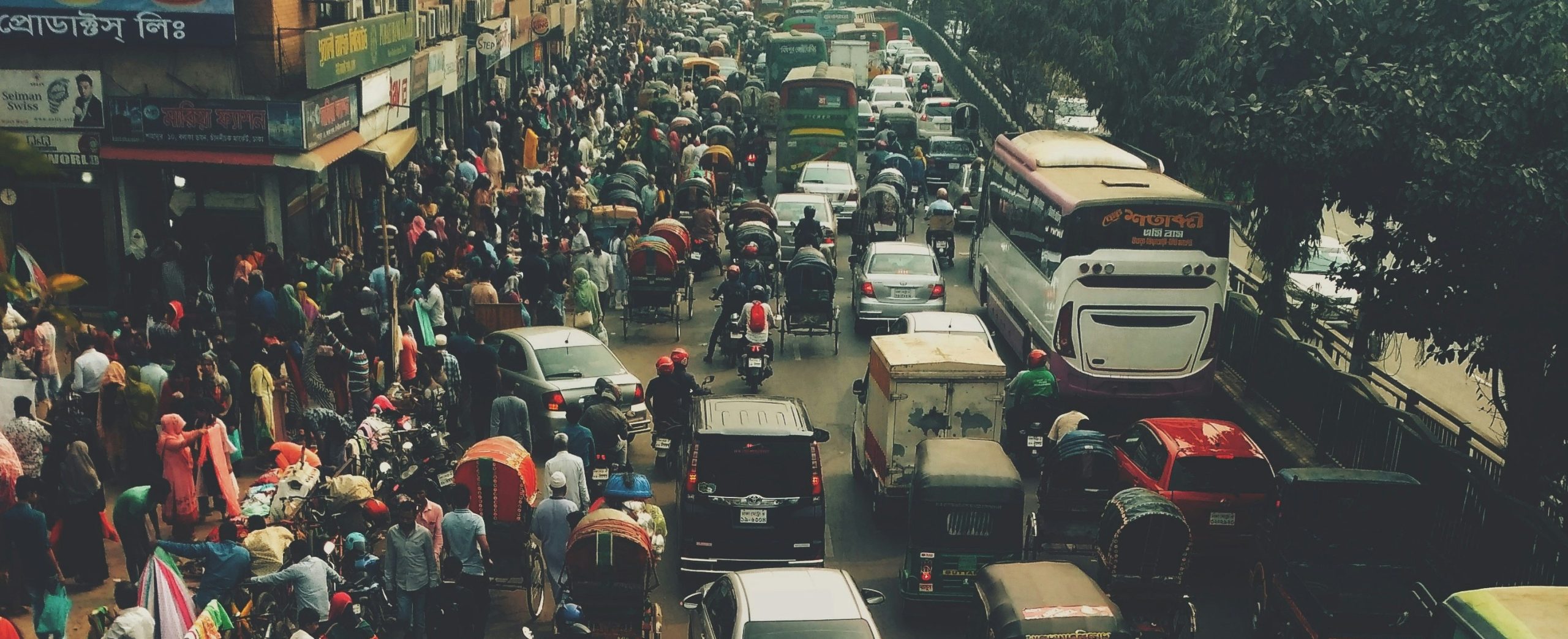
Bangladesh’s economy, long driven by the ready-made garment sector and characterised by sustained growth, has revealed its structural weaknesses since 2024. The political crisis following the student protests, institutional instability, and the fall of the government weakened investor confidence, worsening an already fragile situation marked by high inflation, a troubled banking sector, and limited export diversification. The IMF has downgraded its growth forecasts and tied its support to ambitious fiscal, banking, and monetary reforms that the interim government is attempting to implement. Despite some signs of recovery — rising exports, higher remittances, and stabilising reserves — the economy remains under pressure. The increase in US tariffs amplifies risks for the textile sector, the backbone of exports. These tensions, combined with a volatile political climate, weigh on the country’s attractiveness and complicate the implementation of reforms essential to its stability.

Navigating the troubled waters of regional geopolitics
The fall of Sheikh Hasina in 2024 has altered Bangladesh’s geopolitical landscape, weakening its privileged relationship with India. The interim government led by Muhammad Yunus seeks to leverage competition between India, Pakistan, and China. India, on the defensive, fears growing Pakistani and Chinese influence, particularly regarding security and infrastructure. Pakistan is strengthening political, commercial, and security ties with Dhaka, while China is expanding its footprint through investments, infrastructure projects, and economic cooperation. Despite these shifts, Bangladesh must maintain pragmatic cooperation with India, an essential economic and security partner.
Bangladesh in a time of uncertainty
The upheaval following Sheikh Hasina’s exile in 2024 and the ensuing political reconfiguration have generated significant instability and economic uncertainty. The 2026 elections, guided by a non-binding Political Charter, offer no guarantee of genuine reform. A postponement of the vote could lead to political deadlock, military intervention, and capital flight. The lack of political predictability, which darkens macroeconomic prospects, together with the risk of declining economic competitiveness due to weakened rule of law, is raising concerns among business communities and international observers.
•
The Briefing Note
•
The author

Laurent Amelot is Research Director at the Thomas More Institute. He is a graduate of the Institut Libre des Relations Internationales et des Sciences Politiques (ILERI) and holds two Master’s degrees: one in International Security and Defense from the University of Lyon 3 (CLESID), and another in Geography and Spatial Planning from the University of Paris IV – Sorbonne. He previously served as editor-in-chief of the journal Outre-Terre and, in 1997, was awarded the Amiral Daveluy Prize. He is currently a lecturer at ILERI and the University of Paris-Saclay, and a member of the Asie21 think tank. His research focuses on South and Southeast Asia, and he also studies China, its foreign policy, and especially the maritime dimension of its power strategy. Within the research team of the Institut Thomas More, he contributes to the programme « The Indo-Pacific Tested by China’s Ambitions » • |
•