

 June 2026 • Note 80 •
The clash between the terrestrial Behemoth and the marine Leviathan
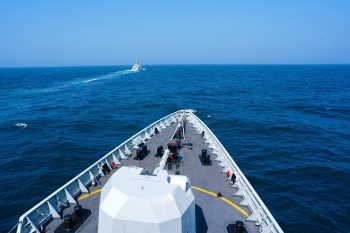
From south to north, the Asian continent is separated from the Pacific Ocean by a succession of marginal seas (South China Sea, East China Sea, Yellow Sea, Sea of Japan, Sea of Okhotsk), which are themselves enclosed by a chain of three archipelagos—Indonesia, the Philippines, and Japan—to which Taiwan is added. None of these islands belong to the continental powers that form a near-continuous coastal line of the three nuclear autocracies: the People’s Republic of China (PRC), North Korea, and Russia. Connecting these seas to one another and to the ocean, strategic straits (Malacca, Taiwan, Bashi, Miyako, Korea, La Pérouse…) constitute vital chokepoints for the trade and fleets of these regimes. The “first island chain” thus forms a potential cangue encircling China, with Taiwan serving as both its lock and its pivot. The stakes can be framed in Schmittian terms: the clash between the terrestrial Behemoth (the autocracies) and the maritime Leviathan (the democracies led by the United States, Japan, South Korea, and the Philippines). Several scenarios are conceivable: a rapid seizure of Taiwan by amphibious assault, a prolonged blockade with severe economic consequences, or a high-intensity war.
The geostrategic importance of the straits near Taiwan
Taiwan’s coastline lies along the major circumnavigation route that connects the world’s leading economies. It is useful to understand the history of China’s maritime modus operandi (from the bloody failure at Jinmen in 1949 and the successful conquests of Hainan and Wanshan in 1950 thanks to the mass requisitioning of fishing boats), U.S. involvement (Truman’s withdrawal, the reversal with the deployment of the Seventh Fleet during the Korean War, the 1954 Mutual Defense Treaty), and then the three Taiwan Strait crises (1954–55, 1958, 1995–96), each marked by Beijing’s retreat in the face of the U.S. aircraft carriers’ power projection capabilities. These setbacks fueled China’s decision to build an ocean-going navy and acquire nuclear weapons. Today, the Taiwan Strait remains a major economic and strategic passageway, the scene of regular freedom of navigation operations (FONOPs) by the U.S., France, etc. and now Japan. The deeper Bashi and Miyako Straits are essential for the covert passage of submarines into the Pacific and for the network of undersea cables.
Taiwan, the central lock of the cangue of the chain of islands
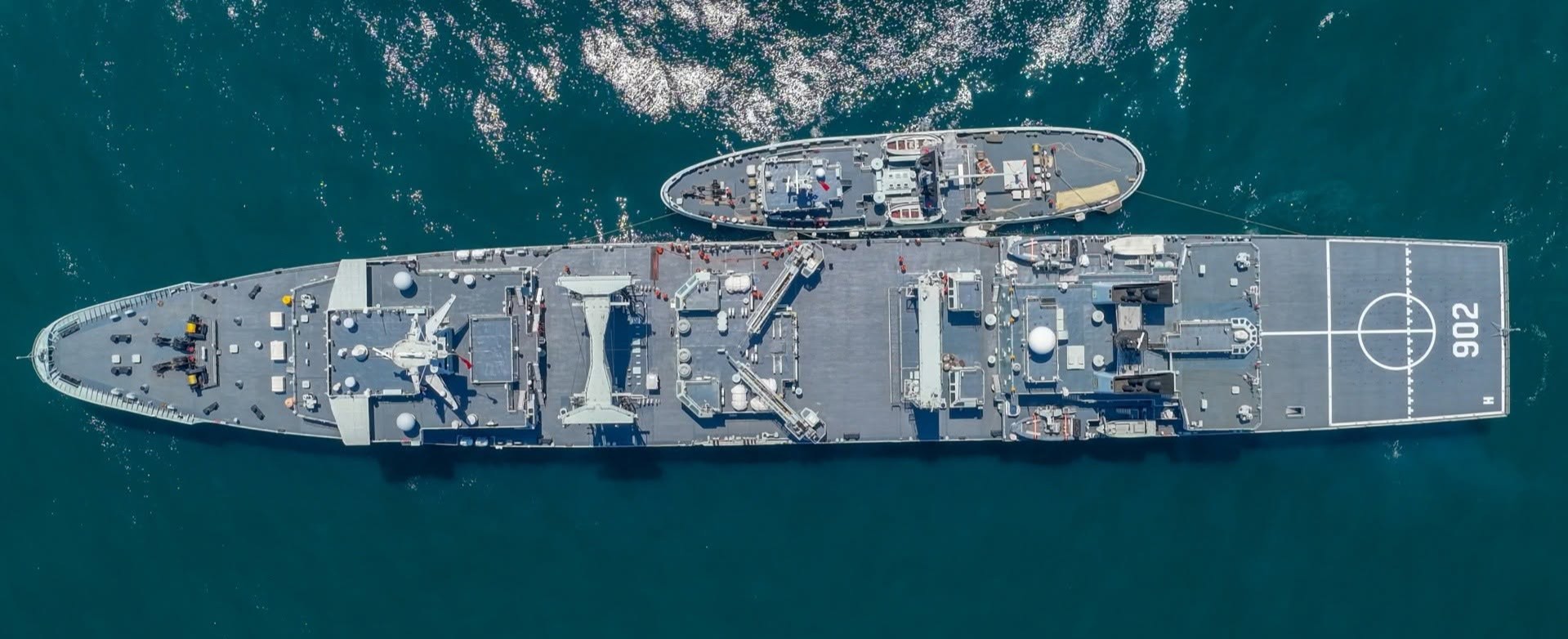
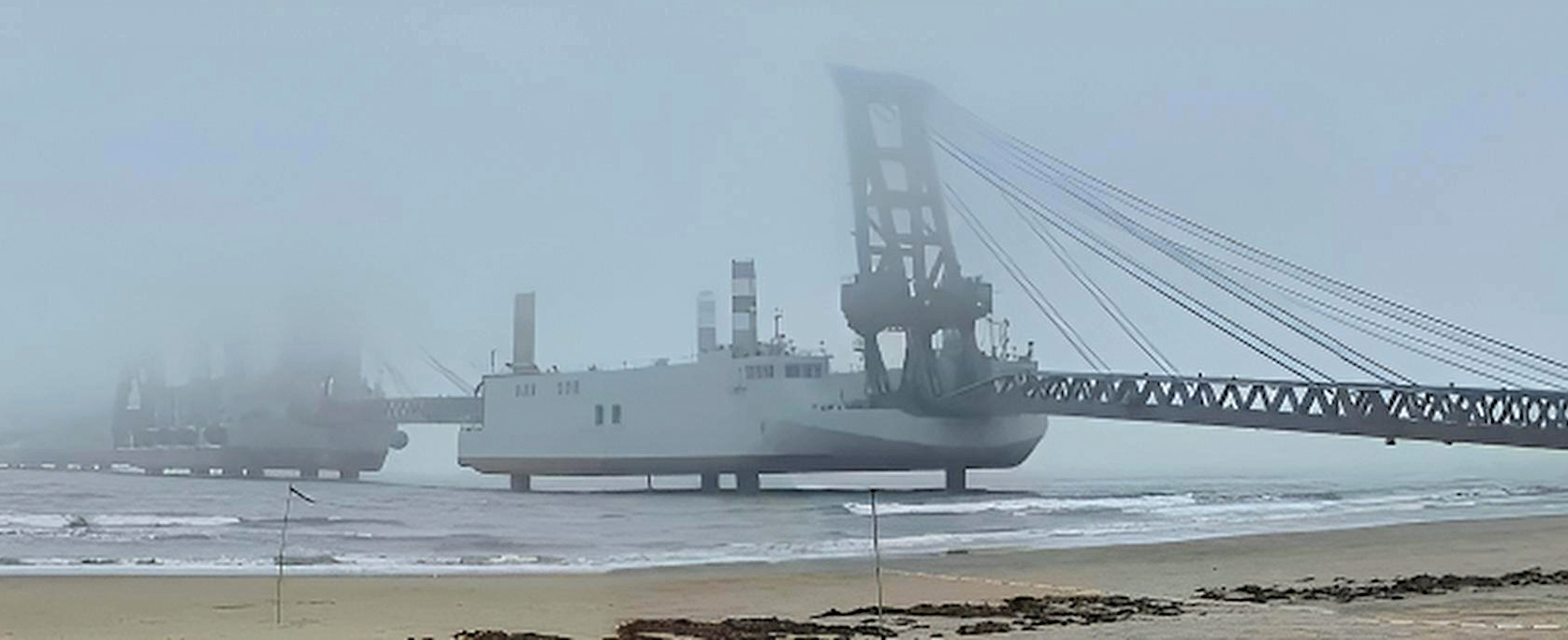
The South China Sea is the only body of water deep enough to shelter the “bastion” where China’s ballistic missile submarines patrol, ensuring a second-strike capability. Confined to its nearby seas, unable to “dilute” its SSBNs in the open ocean, China has established outposts in the Paracels and a naval air complex in the Spratleys. The report details the capabilities intended to break this cangue: an effectively executed aircraft carrier program (Liaoning, Shandong, Fujian, and the future nuclear-powered Type 004, with a goal of nine carriers by 2035), amphibious assault ships, Shuiqiao floating docks, marine corps, and special forces. The new crises since 2022 (response to Nancy Pelosi’s visit, Justice Mission 2025 exercises, gatherings of 1,700 fishing boats) have created a state of simmering conflict and a familiarization to the threat aimed at lowering Taiwanese vigilance. In the event of a high-intensity war, the submarine battle would be decisive: “aircraft carrier killer” missiles, mine warfare in the straits, the AUKUS partnership, and the revitalization of the submarine forces of Japan, South Korea, and Taiwan (Hai Kun). Unlocking Bashi would be essential for Beijing to unleash its deterrence – which in itself justifies the takeover of Taiwan.
The near-continuous coastal stretch of the three nuclear autocracies
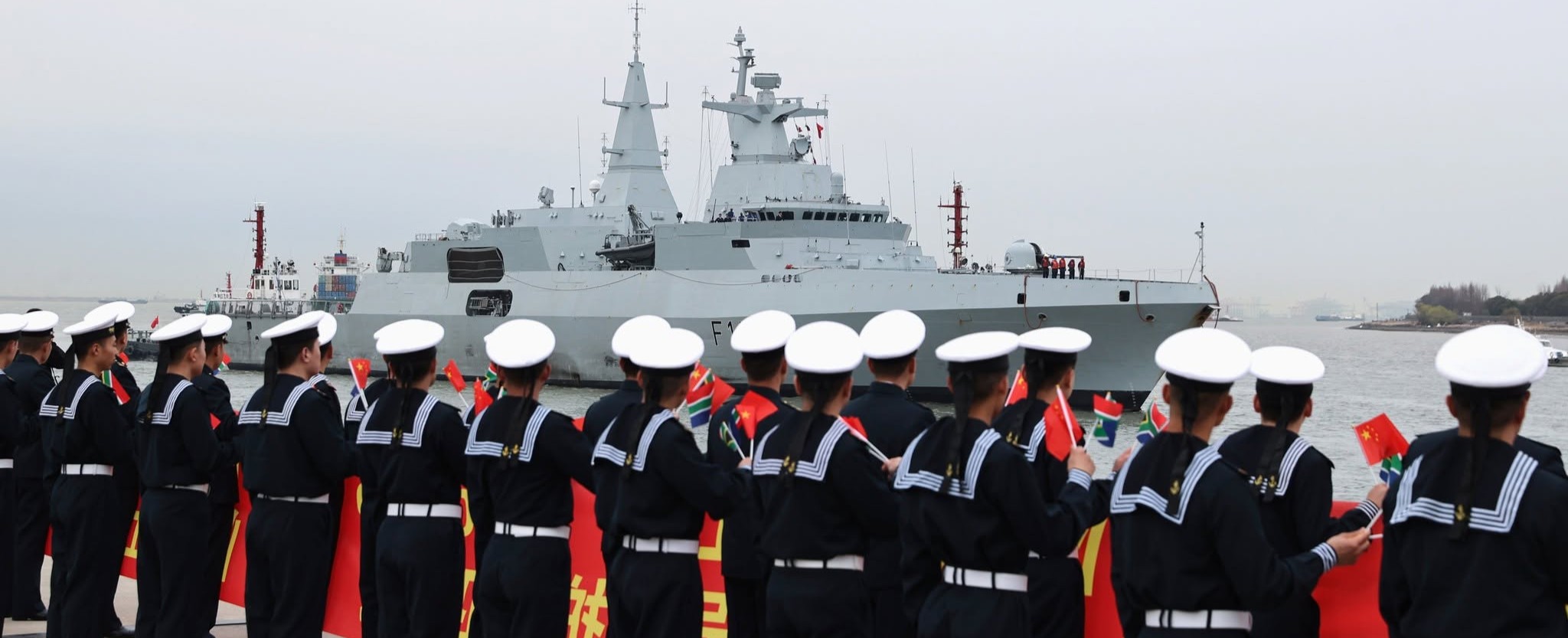
Taking a long-term view, one must trace Russia’s expansion toward the Pacific, from the Cossacks of the 17th century to Peter the Great and Bering’s expeditions, all the way to the ongoing quest for access to open waters connecting Murmansk to Vladivostok. It recalls the Sino-Russian treaties: Nerchinsk (1689) and the “unequal treaties” of Aigun (1858) and Beijing (1860), through which Russia wrested from China the part of Siberia south of the Amur River and founded Vladivostok. The naval disaster at Tsushima (1905) illustrates Russia’s need for a Northeast Arctic route, which global warming has now made navigable. This third part then examines the alliances of the Behemoth: North Korea, Moscow’s only true ally, and China, its partner, linked by increasing joint military exercises. But the weight of historical disputes should not be underestimated: China, whose thinking is rooted in the long term, has not forgotten the loss of Siberia and could, in the long run, demand reparations. The rivalry for control of the straits and Arctic routes could pit a China that has become a maritime power against a Russia that has remained a land power.
Doubts and uncertainties
Taiwan, a strategic hub for major shipping routes and a potential lock for the cangue, poses a major threat to China’s primarily maritime economy. Xi Jinping’s desire to resolve this issue quickly, however, is hampered by the uncertainty surrounding an offensive whose failure would have disastrous political consequences. This could explain the successive dismissals at the top of the People’s Liberation Army (PLA), whose highest-ranking officers reportedly believe, according to some sources, that they are not ready.
•
Download the note
•
The author

Hugues Eudeline is a research director at the Thomas More Institute. A former naval officer and engineer, he holds a Ph.D. in military history, defense, and security from the École Pratique des Hautes Études (EPHE, Paris), and is a graduate of the French higher military education system (École supérieure de guerre navale and Cours supérieur interarmées, Paris) and the United States (Naval Command College, Newport) and holds a Master of Science (Salve Regina University, Newport). Previously a lecturer at Sciences Po Paris, ESCEM, and ICES, as well as a speaker and essayist, he devotes his research to the geopolitics and geostrategy of the global ocean. He is a specialist in maritime China in particular. In 2022, he received the General Maritime Strategy Award from the French Naval Academy (Académie de Marine) and the Silver Medal from the Royal Swedish Naval Academy, of which he has been a corresponding member since 2013. He is the author of Géopolitique de la Chine. Une nouvelle thalassocratie (PUF, 2024) • |